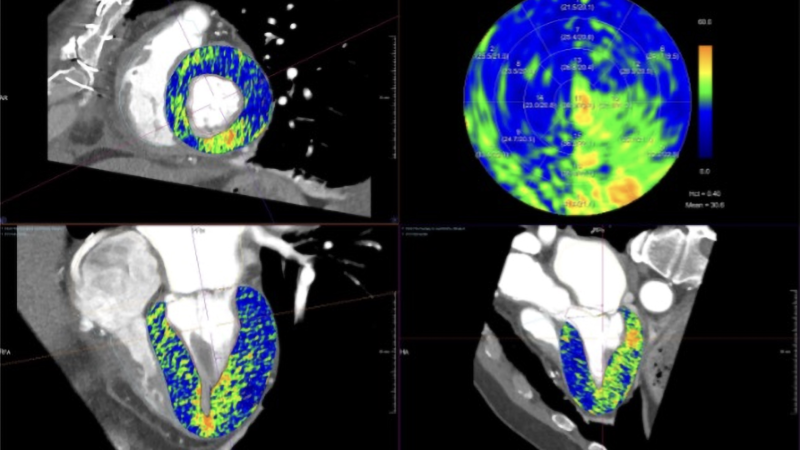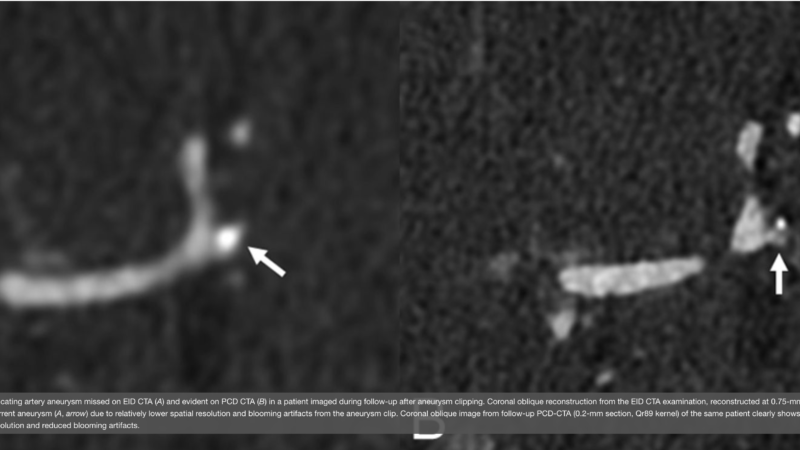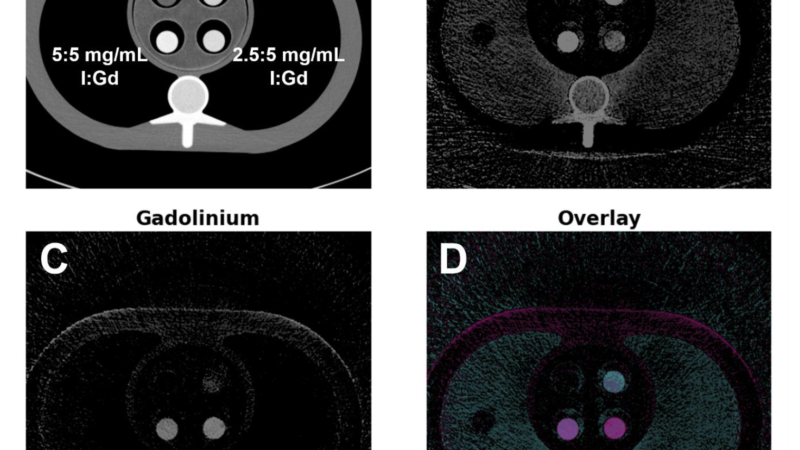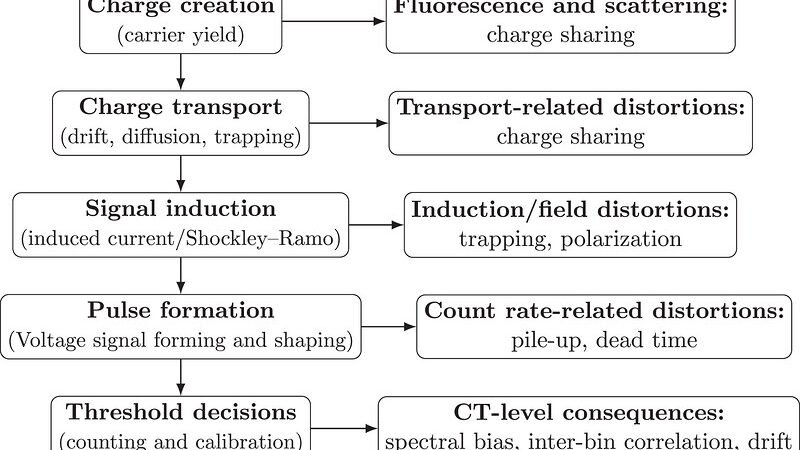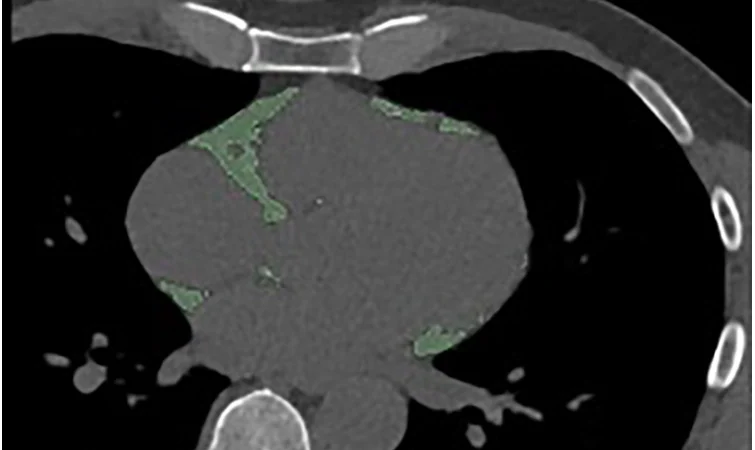


Welcome, fellow creatures of the radiology night. I have counted photons for four centuries, and tonight I get to count something new: a second detector. GE HealthCare has joined Siemens Healthineers in the small club of vendors with an FDA-cleared photon-counting CT (PCCT) scanner.
Key takeaways
- GE HealthCare’s Photonova Spectra received FDA 510(k) clearance on March 23, 2026, making it the second major vendor with an FDA-cleared PCCT system in the US, after Siemens Healthineers’ Naeotom Alpha [1][2].
- GE states Photonova Spectra’s silicon-based “Deep Silicon” detector offers 8-bin energy resolution. Siemens’ Naeotom Alpha uses a cadmium telluride (CdTe) detector that the company describes as offering up to four energy bins [1][3].
- No peer-reviewed clinical or phantom study of Photonova Spectra’s image quality or dose performance has been published. Every specific performance figure attached to this clearance is vendor-stated [1].
- Silicon and CdTe have well-documented physics trade-offs in stopping power and potential energy resolution. Which design performs better in this particular commercial scanner has not yet been shown in independent research [5].
A second vendor reaches the US PCCT market
On March 23, 2026, GE HealthCare announced that its Photonova Spectra scanner received FDA 510(k) clearance [1]. The system debuted at RSNA 2025 the previous November, and the clearance confirms it can now be marketed in the United States [1].
That makes GE HealthCare the second major CT vendor with an FDA-cleared photon-counting CT system, ending Siemens’ several-year run as the only one [2]. Siemens’ Naeotom Alpha was the first PCCT system cleared by the FDA, back in September 2021 [7].
One footnote deserves front-page treatment. GE’s own press release states plainly that Photonova Spectra is not CE Marked and is not available for sale in Europe, Canada, or anywhere else yet [1]. Readers outside the US will be waiting a while longer.
Deep Silicon versus cadmium telluride: comparing the detectors
Photon-counting detectors work by catching individual X-ray photons and sorting them by energy, rather than converting the whole X-ray beam to light first the way conventional CT detectors do. GE’s Deep Silicon detector and Siemens’ CdTe-based QuantaMax detector solve that problem with different materials, and the materials come with real trade-offs.
GE states Photonova Spectra sorts photons into 8 energy bins [1]. Siemens describes Naeotom Alpha as measuring energy in up to four bins [3]. More bins can, in principle, allow finer distinction between tissues and contrast materials, but bin count alone does not establish a clinical advantage, and no published study compares the two systems head to head.
Silicon has substantially lower X-ray stopping power than CdTe at the same thickness: roughly 5% absorption efficiency for silicon versus about 90% for CdTe at equivalent thickness [5]. That is why GE’s Deep Silicon design, developed from research GE acquired via Prismatic Sensors, orients the silicon “edge-on” to the beam. The detector element has to be physically long to absorb enough high-energy photons to compensate for silicon’s thin-slice weakness [1][5].
The theoretical upside of silicon is finer potential energy resolution. Whether that theoretical edge survives contact with a real gantry, a real patient, and real clinical workflow is exactly what has not yet been published [5].

Image: GE’s “Edge on” detector design, GE Linked article
What GE claims, and what has actually been shown
GE’s press release attaches several specific numbers to Photonova Spectra. The scanner reportedly rotates in 0.23 seconds and offers wide detector coverage intended to support fast, motion-reduced acquisition [1]. GE also states the system can process “up to 50 times more data” than conventional CT (GE’s own prior scanner, the Revolution Apex Elite) [1].
The press release quotes one clinician, from a GE-designated evaluation site at the University of Wisconsin, describing positive impressions from evaluative studies [1].
Trade press coverage adds useful market context: Citi Research analysts told MedTech Dive that GE’s detector produces high-contrast spectral images and that designing the scanner to fit existing CT room footprints could ease hospital adoption, an analyst opinion rather than a measured result [2]. The same coverage notes Siemens’ CEO stated the company’s PCCT business had generated roughly €1 billion in orders and €700 million in revenue, a reminder that Siemens currently holds the established commercial lead in this segment [2].
Reading a 510(k) clearance honestly
An FDA 510(k) clearance means the agency found Photonova Spectra substantially equivalent to an already-marketed device [1]. As with any FDA 510k clearance, it is a regulatory bar, not proof of superior image quality, dose performance, or diagnostic accuracy. At the moment I write this article there no published clinical trial, peer-reviewed paper, or independent phantom study accompanies this clearance [1].
That leaves several open questions worth watching.
Will GE publish independent, peer-reviewed data on Photonova Spectra’s spatial resolution, spectral separation accuracy, noise, and dose performance, ideally compared directly against Naeotom Alpha?
Does 8-bin resolution translate into a measurable diagnostic advantage over 4-bin CdTe, or is bin count a specification that sounds better than it performs?
How does silicon’s lower per-thickness stopping power affect dose efficiency in high-flux settings like cardiac and high-attenuation body imaging, once the edge-on geometry is doing the work in an actual patient?
GE has announced research collaborations with UW–Madison and Stanford Medicine, and whether those produce peer-reviewed findings is worth watching [1].
FAQ
What is GE’s Photonova Spectra?
Photonova Spectra is a photon-counting CT (PCCT) system from GE HealthCare that received FDA 510(k) clearance on March 23, 2026. It uses a silicon-based detector GE calls “Deep Silicon” [1].
How is Photonova Spectra different from Siemens’ Naeotom Alpha?
The two systems use different detector materials. GE’s Deep Silicon detector is silicon, oriented edge-on to the X-ray beam, and GE states it offers 8 energy bins. Siemens’ Naeotom Alpha uses a cadmium telluride detector that Siemens describes as offering up to four energy bins [1][3]. No independent study has compared their clinical performance.
Has Photonova Spectra been tested in patients?
GE’s clearance announcement references unpublished “evaluative studies” and quotes one clinician at a GE-designated evaluation site. No peer-reviewed clinical trial or phantom study has been published as of this clearance [1].
Is Photonova Spectra available outside the United States?
No. GE’s own press release states the system is not CE Marked and is not available for sale in Europe, Canada, or any other region [1].
What does FDA 510(k) clearance actually mean?
It means the FDA determined the device is substantially equivalent to an already-legally-marketed predicate device. It is a market-access pathway, not a judgment about clinical performance [1].
References
1. GE HealthCare. “GE HealthCare’s Photonova Spectra photon-counting CT receives FDA clearance.” Press release. 2026.
2. Taylor, Nick Paul. “GE HealthCare wins FDA nod for photon-counting CT technology.” MedTech Dive. 2026.
3. Siemens Healthineers. “Photon-counting CT by Siemens Healthineers: Quantum Technology.” Vendor materials.
4. GE HealthCare/Business Wire. “GE Healthcare Pioneers Photon Counting CT with Prismatic Sensors Acquisition.” 2020.
5. “Photon-counting CT systems: A technical review of current clinical possibilities.” ScienceDirect. 2024.
6. “Siemens’ Naeotom Alpha Computed Tomography Imaging Device, USA.” Medical Device Network.
7. “First Photon-counting CT System Cleared by the FDA.” Diagnostic and Interventional Cardiology (DAIC). 2021.

I shall be watching for the peer-reviewed data with all the patience four centuries afford, dear reader. The moment independent evidence arrives, so will a follow-up post.
Sign up for The Count Photon newsletter to get the next installment of this vendor comparison the moment real data lands.
Educational content, not medical advice. Count Photon explains imaging technology and published research for educational purposes. Nothing here is medical advice, and it should never replace a conversation with a qualified healthcare professional about your own care.