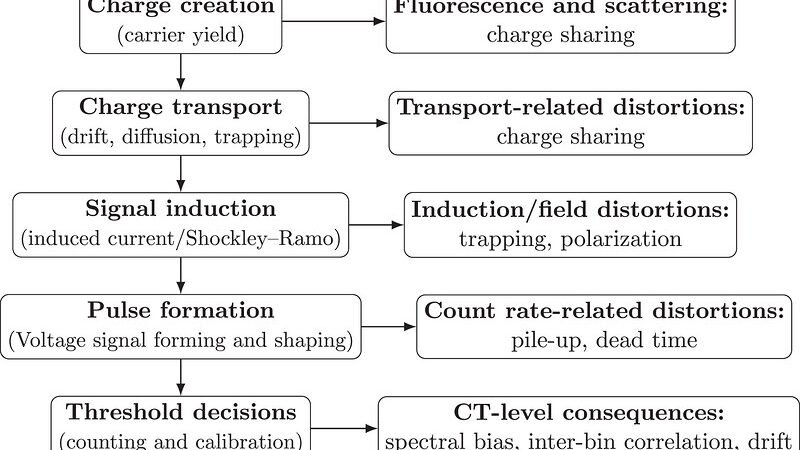

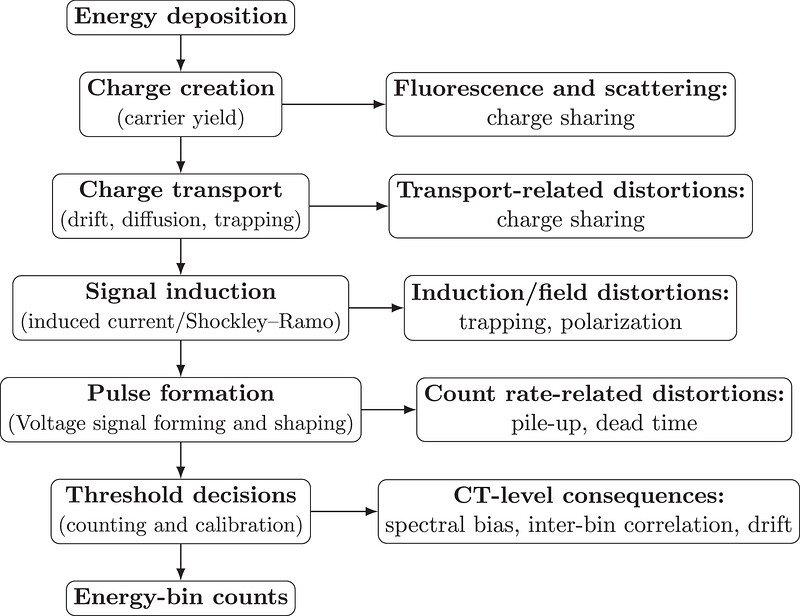
Figure 2:
Causal measurement chain linking post-object photons to energy-binned digital output in a photon-counting detector. A PCD does not measure photon energy in a single step; rather, energy-binned counts emerge through a linked sequence of interaction physics, charge creation and transport, signal induction, pulse formation, and threshold-based counting. The side branches indicate representative mechanisms that perturb specific stages of this chain and thereby produce CT-relevant consequences such as spectral bias, inter-bin correlation, and stability drift. https://aapm.onlinelibrary.wiley.com/doi/10.1002/mp.70586

Welcome, fellow creatures of the radiology night. Tonight I invite you into the one room even I approach carefully: the inside of a photon-counting detector, where every count I love so dearly actually begins.
Key takeaways
- A 2026 tutorial in Medical Physics organizes the physics of photon-counting CT (PCCT) detectors into one causal chain, from x-ray absorption to threshold-binned counts [1].
- Charge sharing is one of several detector-level effects, alongside pixel geometry, dead time, pulse pile-up, dark current, and contact leakage, that shape spectral response and count-rate performance [1].
A teaching paper, not a new experiment
In A physics primer on photon-counting detectors in CT, physicists Guang-Hong Chen and Ruiran Lai at the University of Wisconsin-Madison, working with Ke Li of MD Anderson Cancer Center, set out to do something narrower than it sounds: connect the physics that everyone in the field already knows into one explanatory sequence [1].
The abstract describes a synthesis of established detector physics, charge sharing, pixel geometry, dead time, pile-up, dark current, and contact leakage, organized around a single chain of cause and effect [1]. The authors argue that earlier physics and engineering reviews of photon-counting CT already cover these operating principles individually but stop short of linking every stage into one framework.
Why write a primer at all, years into the clinical rollout of these scanners? Because “photon-counting” describes an ideal, not a direct readout. A pixel’s threshold-bin count is the last surviving signal after five or six physical and electronic steps have already happened to it, and most clinical conversations about PCCT skip straight to that final number without describing the road it traveled.
The causal chain
The primer walks the same road every time, in this order: energy deposition, charge creation, charge transport, signal induction, pulse formation, and finally event counting with multi-threshold energy binning [1].
Put in plainer terms: an x-ray photon deposits its energy in the semiconductor. That energy knocks loose a cloud of electrons and holes proportional to how much energy the photon carried. The cloud drifts toward the pixel electrodes under an applied electric field.
Its arrival induces a pulse of current, which electronics shape into something with a measurable height. Comparator circuits then check that height against one or more voltage thresholds and sort the event into an energy bin [1].
Every step in that chain is a place where the signal can drift from the ideal. The primer’s stated contribution is treating all of them as one continuous story rather than a set of separate footnotes [1].
Charge sharing: one photon, two neighbors
One photon arrives near a pixel boundary. Its electron-hole cloud spreads as it drifts, and by the time it reaches the electrodes, part of the charge lands in one pixel and part in the neighbor [1].
The result is two smaller, mismeasured events where there should have been one correctly measured one. The primer places charge sharing alongside pixel geometry as a first-order limit on how faithfully the detector reports each photon’s true energy [1].
The other culprits: pile-up, dead time, dark current and leakage
Charge sharing shares the stage with four other effects the primer folds into the same framework [1]:
- Pulse pile-up: two photons arrive close enough in time that the electronics register one large, mismeasured pulse instead of two separate events.
- Dead time: the brief window after an event during which the detector cannot reliably process the next one.
- Dark current and leakage current: small currents that flow through the detector material and its contacts with no x-rays present at all, adding noise and instability.
Together these mechanisms set four measurable performance limits: spectral response, count-rate performance, threshold stability, and reproducibility at clinical flux [1].
None of that is new physics. It is, by the authors’ own account, a consolidation of what physicists already knew, organized so a reader can follow one thread from absorption to output instead of assembling it from several papers [1][2].
FAQ
What is charge sharing in a photon-counting CT detector?
It is what happens when the electron-hole cloud from one absorbed x-ray photon spreads across the boundary between two adjacent pixels, splitting one photon’s signal into two smaller, less accurate signals [1].
What is pulse pile-up, and why does it matter?
Pile-up occurs when two photons arrive close enough in time that the detector electronics register them as one larger, mismeasured pulse instead of two separate events. It limits how much flux a photon-counting detector can handle accurately [1].
Is this primer based on new experimental data?
No. It is a tutorial review that organizes established detector physics into one framework. It reports no new phantom, patient, or dose measurements [1].

Four hundred years of counting grains of rice prepared me for very little in this life, dear reader, except perhaps this: patience for a physics primer…
Enjoyed untangling detector physics with me? The Count Photon newsletter brings one new dossier like this to your inbox every week, hedges intact.
Educational content, not medical advice. Count Photon explains imaging technology and published research for educational purposes. Nothing here is medical advice, and it should never replace a conversation with a qualified healthcare professional about your own care.
References
1. Chen G-H, Lai R, Li K. A physics primer on photon-counting detectors in CT: Physics, signal formation, and performance. Medical Physics. 2026.
2. Chen G-H, Lai R, Li K. A physics primer on photon-counting detectors in CT (authors’ framing on prior reviews). Medical Physics. 2026.